

Innovation Prototyping Labs: Making Space for Higher-order Questions
Authors: Andrew Dubber and Michela Magas
Knowledge graphs are not just catalogues of entities and links. They also need to carry the rules that make a domain legible. The first GRAPHIA IPL in Zagreb explored how co-creation methods surface those rules, and how higher-order approaches can help make them explicit and checkable.
When researchers from different domains explore a subject without trying to converge on a single viewpoint, new and qualitative connections begin to form. Insights from one area attach themselves to the conceptual structures of another. It is more like higher-order reasoning than simple aggregation, because what emerges is not only new facts but new relationships between categories, methods, and assumptions. That is often where new research directions arise, with an immediacy that formal procedures struggle to produce.
From 1 to 3 October, the first Innovation Prototyping Lab (IPL) for the GRAPHIA project focused on stimulating novel knowledge connections. Research is often framed as a sequence of procedures that promotes conformity of method and expectation. Such structures have their place, but they seldom reflect how researchers arrive at distinctive research questions. Each person arrives with a distinctive background, a particular route into their field, and an internal map of associations shaped by years of experience.
When those maps are forced into a standard template, the conditions that allow new questions to appear are weakened. What gets lost is not detail so much as level: everything is pushed down to description, things, attributes, and a limited set of relationships between them. Many of the questions we care about in complex systems sit above that, because we need to reason about relationships between relationships, and about the rules by which patterns hold across different cases.

The GRAPHIA IPL was designed as a practical counterweight to that flattening. Each workshop leader shaped their session around their own objectives and methods, while participants were encouraged to approach shared material from their own intellectual vantage points. Rather than smoothing out differences, the work relied on them.
For GRAPHIA these connections are not a by-product: they are the work. Mapping knowledge at domain level depends on recognising common structures, yet the value of those structures appears only when researchers extend them with their own perspectives. In practice, the important part is often not a list of entities and links, but the constraints that sit over relationships: what counts as the same thing in a given context, what counts as evidence, what sorts of connections are allowed, and at what level. A good map carries conventions about what the symbols mean and what can be inferred at different scales.
One of the ways in which researchers formalise those conventions when the system is too complex to capture as a simple catalogue is Higher-order logic (HOL). It gives a way to state rules about relationships, including rules that refer to other rules, so they can be inspected and tested rather than left implicit. In that sense, a knowledge graph is less like an index and more like a map that can hold both the features and the rules that make them legible.
That matters even more as research tools become increasingly dependent on AI. The knowledge graph allows digital tools to be grounded in meaning and in the connections between established intellectual foundations. If we want machine assistance without semantic drift, we need frameworks that can state and check the higher-level constraints of a domain. Without that, the system may still produce fluent output, but it will not reliably respect the domain’s own rules.
This is why higher-order approaches appear in verification practice: they can express properties of complex systems that must remain true in a way that can be tested, rather than merely asserted. The Zagreb lab gave us a practical setting to see how those principles play out in real time across disciplines and roles.
Colocation with the LUMEN project enriched the work by connecting across domains. Where GRAPHIA offers orientation within the Social Sciences and Humanities, LUMEN opens routes into other areas where relevant material and methods may be found, without asking researchers to abandon their own conceptual ground.
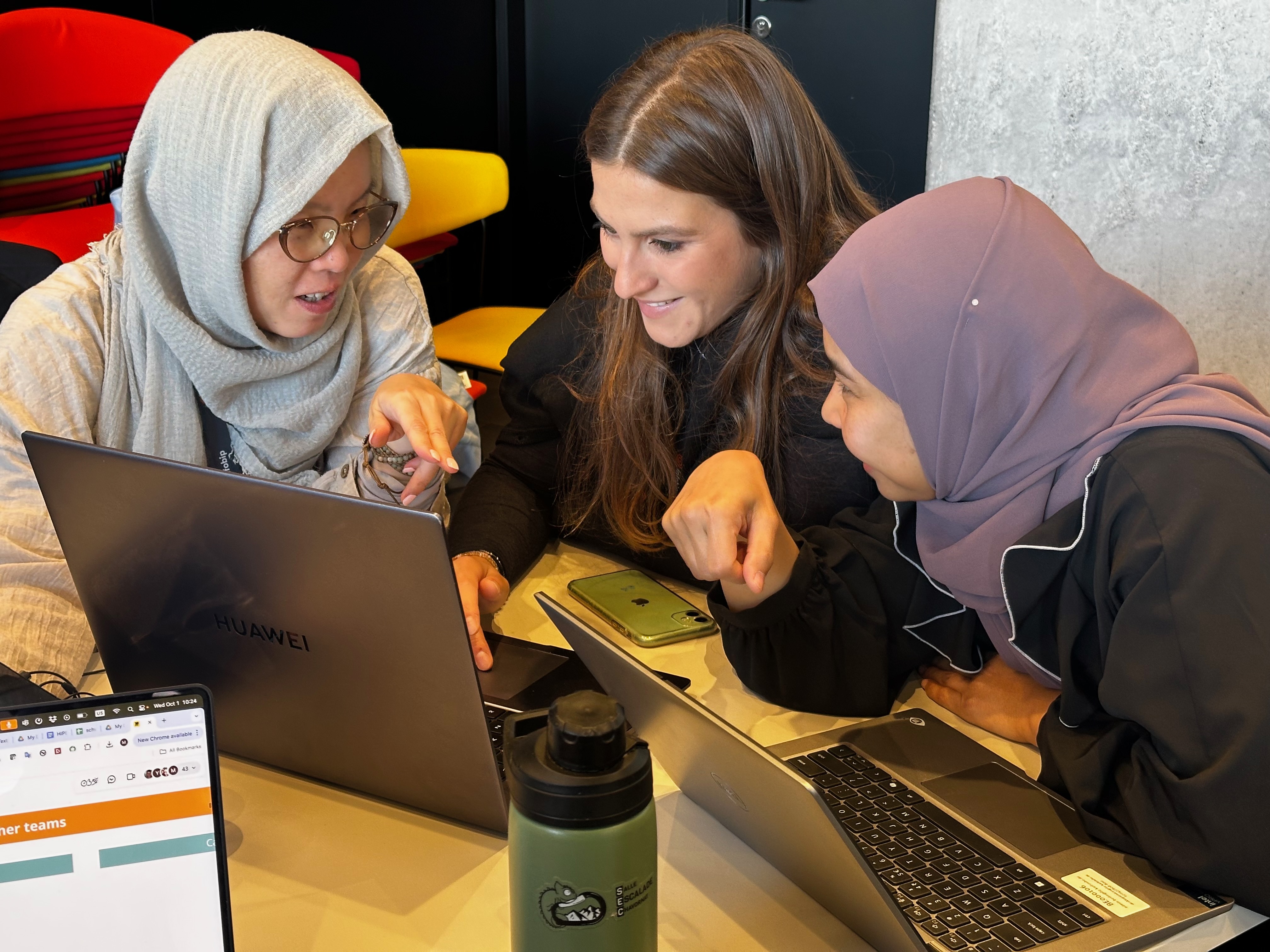
Further connections were enabled in our special sessions with partners and industry. Our global brainstorming session launched the call for papers for the CERN Journal of Experimental Innovation special issue on co-creation, where outside contributors joined remotely and brought their perspectives into the room from across Europe. Presentations, discussions and workshops with industry partners such as the hosts Infobip and guests Metaphacts held the work close to real constraints and open questions.
On the strength of this first lab, project coordinators have asked us to bring more of these methods into next year’s IPL, allowing the projects to iterate through repeated cycles of work, which will ensure our future maps of knowledge can be defined by the quality of the questions they allow us to ask, and not simply the data they hold.
______
You can browse the recordings of the 2025 IPL on the GRAPHIA YouTube channel. Sign up to the GRAPHIA mailing list for news on future IPL events here.