

From maturity to evidence: testing a readiness approach with GRAPHIA pilots
Authors: Elena Sokolova (OPERAS), Magdalena Wnuk (IBL PAN)
How do we know when an innovative research service or tool is ready to move forward – and what exactly needs to happen next?
On 14 September 2026, the OPERAS Innovation Lab and GRAPHIA project brought together pilot teams for a hands-on workshop focused on this question. The workshop took place as part of the Innovation Prototyping Lab (IPL2) 2026, a week-long co-creation event bringing together the GRAPHIA and LUMEN communities in Brussels. The session tested the OPERAS Innovation Framework, developed around ten dimensions of innovation assessment, against real GRAPHIA pilots and use cases. The aim was practical: help teams understand where their solutions currently stand, identify the most important gaps, and define the next steps toward adoption, exploitation, and sustainability.
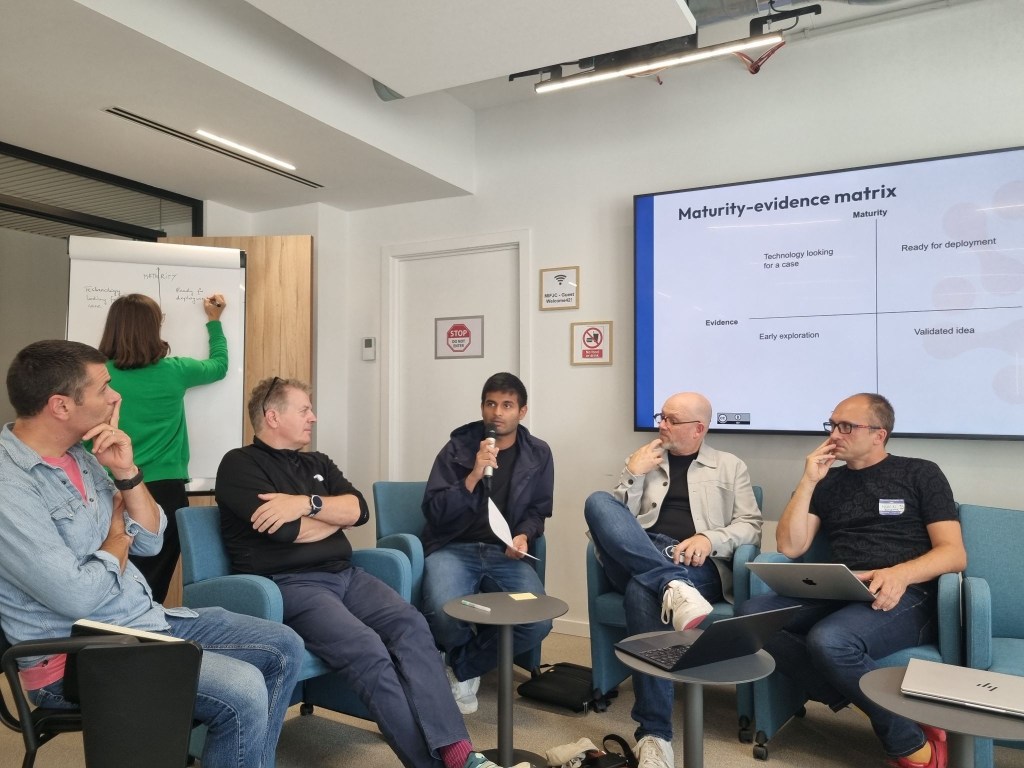
Mapping readiness beyond a single scale
The first exercise used a simple two-dimensional readiness map, looking at two factors separately: solution maturity and supporting evidence.
The map distinguishes between four broad situations: early exploration, a validated idea or opportunity, technology looking for a case, and readiness for deployment. Teams reflected on five questions: what they are developing, what evidence they already have, what they are still assuming, what is holding them back, and what would allow them to move forward.
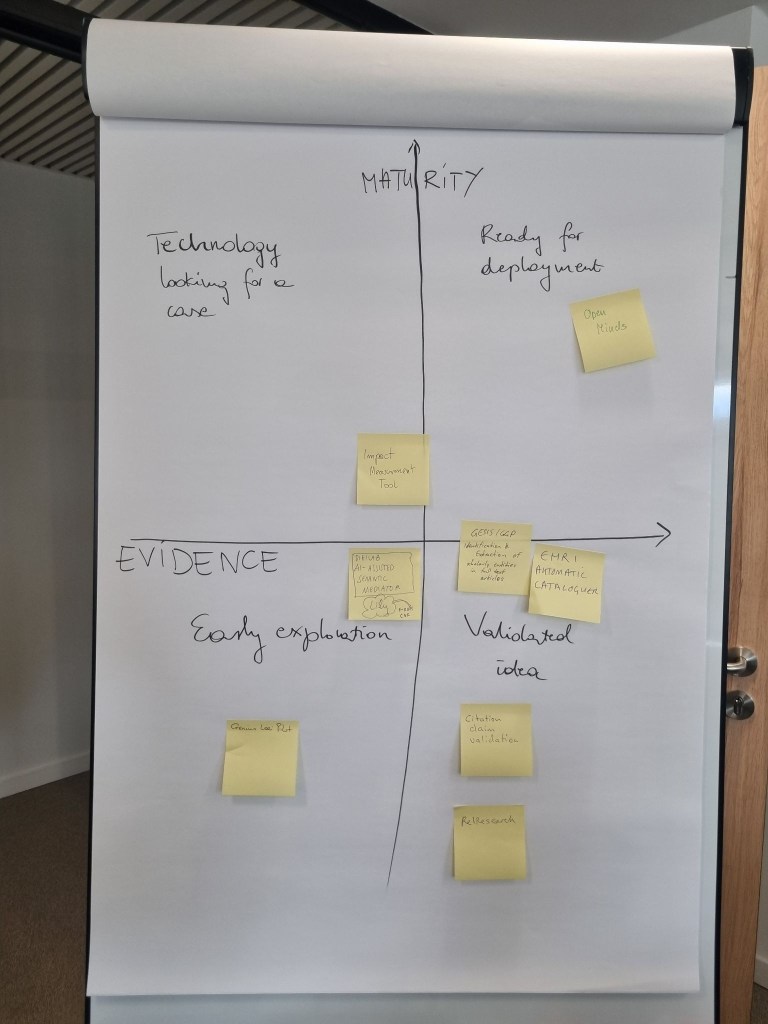
Eight pilots and use cases were mapped during the session:
- Digilab AI-Assisted Semantic Mediator for SSH;
- IMeTo: Impact Measurement Tool;
- GESIS/GGP: AI-powered information extraction for exploiting survey variable and survey data usage in scholarly publications;
- ReIReSearch.
- Open Minds;
- EHRI: Cataloguing & Labelling Tool (EHRI-CATE);
- Citation Claim Validation;
- Genius Loci Pilot: AI-powered KG data extraction for geospatial data.
The resulting map was particularly revealing because the cases did not fall neatly along a single progression from “early” to “advanced”. The exercise highlighted something that a single maturity score can easily hide: technical or product maturity and the strength of evidence do not necessarily develop at the same pace. A relatively mature solution may still need stronger validation, while another may have a well-established need and evidence base but still require substantial development.
From diagnosis to action
The second part of the workshop moved from “Where are we?” to “What should we do next?”
Teams worked with an Innovation Development Canvas structured around three areas – Idea, Adoption/Conversion and Exploitation – drawing on the ten dimensions of the OPERAS Innovation Framework. They then identified critical gaps and concrete next steps: what still needs to be learned, tested, improved or developed, and what evidence would reduce the remaining uncertainty.
| IDEA Novelty: what makes this product unique? Utility: which user needs does it address? | Who needs it? What problem does it solve? | ADOPTION/ CONVERSION User Engagement: how will it be used? User Responsivenes: can it adapt to different contexts? Support & Training: how will users be enabled? | Who will use it? In what context? What kind of support is needed? | EXPLOITATION Impact & Collaboration: who benefits beyond users? Bridging potential: is it cross-sector? Sustainability: how is long-term maintenance planned? Peer Review / Validation: how is credibility built? Reusability / Reproducibility: can it be scaled or shared? | Who could benefit beyond our current pilot? Could it cross sectors? Who could help take it further? |
| Value What value does it create for the user? | Design What needs to be tested, adapted or improved for adoption? | Maintenance How could it be maintained, validated, reused, reproduced or scaled? | |||
| Critical Gaps What is the biggest uncertainty, gap or challenge right now? What is preventing us from moving forward? What do we need to learn, test or develop to address it? What evidence would reduce this uncertainty? | Next steps What is the next concrete action? Who needs to do what, and by when? | ||||
Both the readiness map and canvas were used as working instruments: a way to connect the current state of an innovation with the decisions and actions required to move it forward.
In the closing discussion, participants highlighted several kinds of value. Some found particular parts of the canvas especially useful for their situation – for example, identifying critical gaps – while others valued the canvas as a whole for providing a broader view of their innovation and what still needs attention. Participants also noted the value of working across pilots: the session created an opportunity to see what other teams are developing, compare perspectives and step outside the individual “bubbles” in which pilots often work.
What comes next
The workshop was also a test of the methodology itself. Feedback from participants will now be used to refine the readiness-mapping approach, the Innovation Development Canvas and the broader OPERAS Innovation Framework. The longer-term ambition is to develop these into reusable tools that the OPERAS Innovation Lab can apply with GRAPHIA and other research and scholarly communication initiatives.
A big thank you to everyone who joined the workshop and contributed their ideas, questions and experience. We’re already looking ahead to IPL3, planned for March 2027, where we hope to continue developing and testing these approaches together!
