

Exploring Emerging GRAPHIA Interfaces at the Second Innovation Prototyping Lab
Authors: Crystal Silver
At GRAPHIA, co-design involves researchers, infrastructure providers, technical specialists, and other stakeholders in the development of future research tools and services. Throughout the project, participants have contributed to discussions around knowledge graph exploration, AI-assisted research, transparency, and responsible AI use.
At the second Innovation Prototyping Lab (IPL2), held in Brussels in September 2026, participants took part in two connected co-design sessions focused on a central question: How should researchers interact with GRAPHIA’s Federated Knowledge Graph? The sessions built on earlier co-design activities and provided an opportunity to engage with emerging interfaces and discuss how future GRAPHIA services might support day-to-day research practices.
Working with a Prototype Interface
The first session, led by Foxcub and Net7, combined a technical overview of GRAPHIA’s evolving knowledge graph infrastructure with a codesign activity exploring an emerging user interface concept.
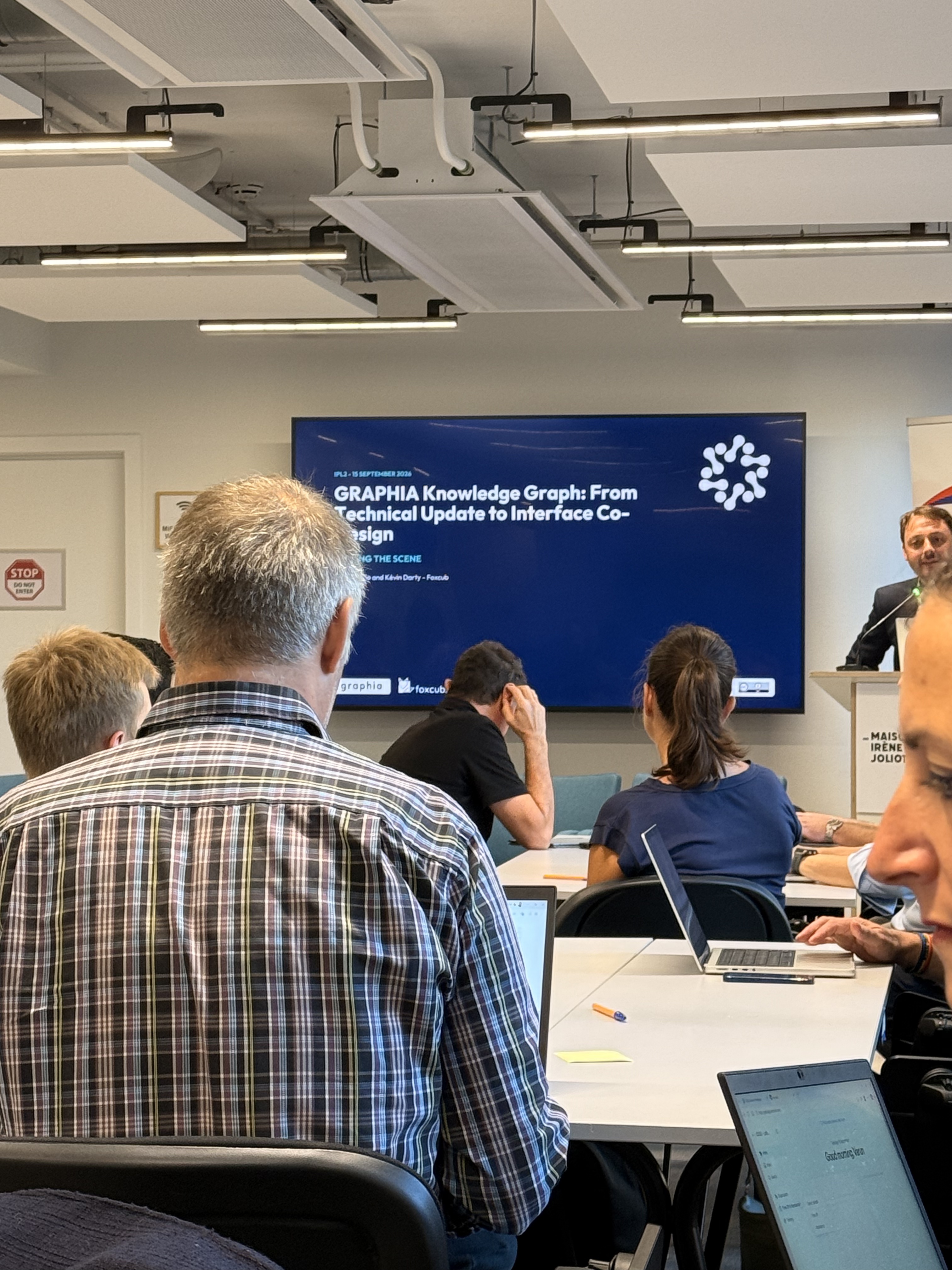
The prototype interface demonstrated how researchers might interact with the GRAPHIA Federated Knowledge Graph. Feedback covered natural language querying, visualisation, metadata, provenance, search and discovery features, workspace management, and collaboration.The activity allowed participants to consider the interface in relation to research workflows, including how different features and representations might work together as researchers move from discovering information to exploring relationships between resources and interpreting results. This hands-on engagement also highlighted the importance of helping researchers understand what information the knowledge graph contains and what they can query.
Talking to Knowledge Graphs
The second session, led by Odoma with support from Abertay University, focused on conversational interaction with knowledge graphs. Participants were invited to interact with either GRAPHIA’s Quagga agent or GraphChat before sharing feedback on their experiences and discussing potential improvements.
Participants responded positively to features such as suggested follow-up questions and explanations of how queries had been handled. Discussions also highlighted the value of making agent actions more visible, providing clearer guidance during interactions, and helping users move easily from conversational responses to the underlying resources.
Familiar Priorities in a new Context
One of the most interesting aspects of both IPL2 sessions was the consistency of the topics participants raised.
Many of the priorities discussed during IPL2 echoed findings that have emerged throughout GRAPHIA’s wider user-centred research programme. Across both sessions, conversations returned to familiar concerns around transparency and provenance, flexible ways of exploring information, access through natural language, and the need to accommodate different research practices.
This consistency is valuable. It suggests that these priorities remain relevant across different stages of development, from early co-design discussions through to the exploration of emerging interfaces and interaction concepts.
The Next Phase of User-Centred Research
The activities at IPL2 helped explore how earlier co-design insights mapped onto evolving tools and services, while identifying areas for further refinement. As more GRAPHIA interfaces and services become available, usability testing will mark the next phase of the project’s user-centred research. Complementing the insights gathered through earlier user research and co-design, this work will examine how researchers interact with GRAPHIA technologies in practice, providing insights into their behaviour, needs, and any barriers they encounter.
